[ THE_SHORT_ANSWER ]
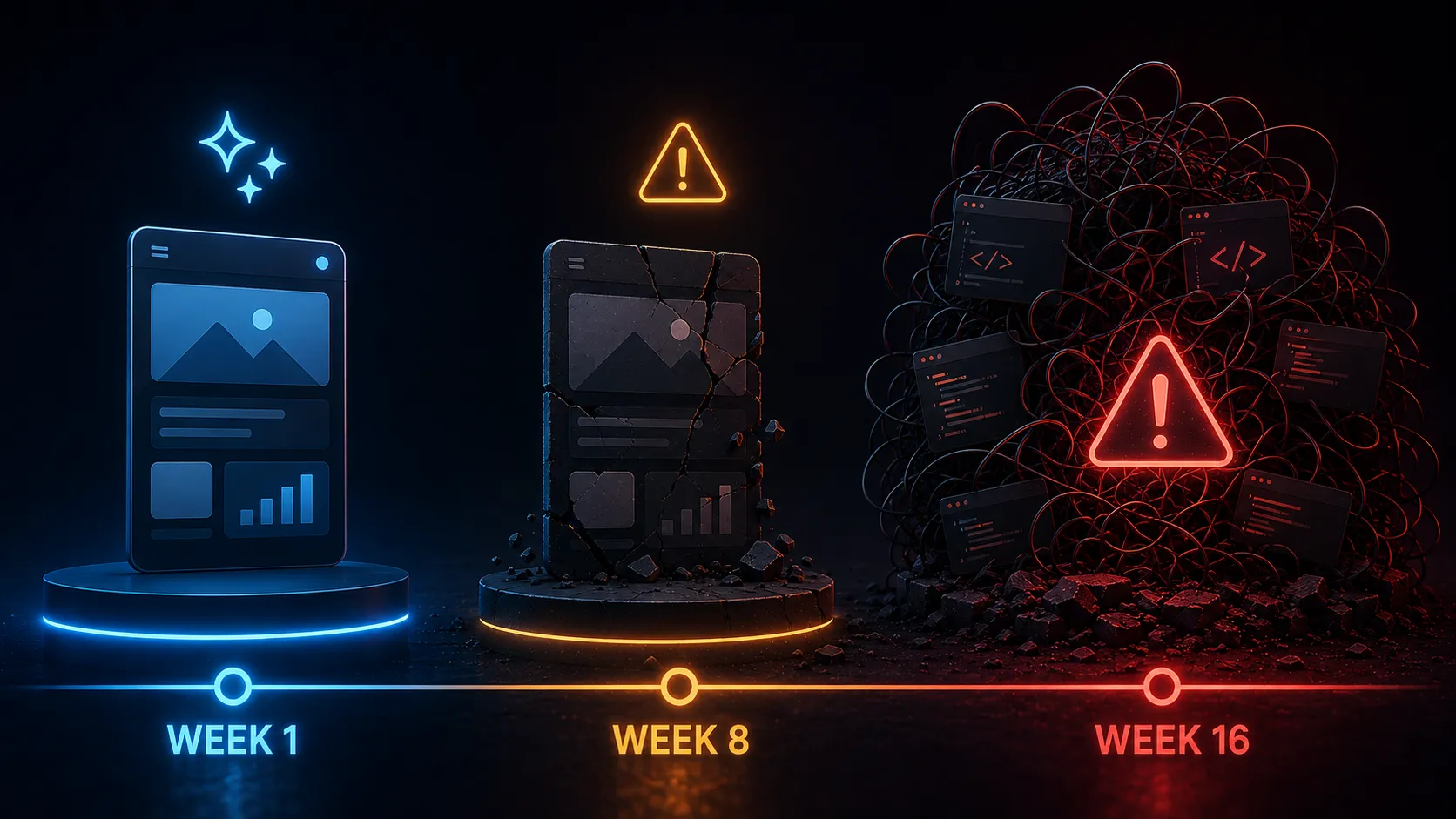
Vibe coding ships fast in week one because AI generates working happy-path code. It collapses by week sixteen because the architecture (state ownership, module boundaries, failure modes) was never designed. The speed you feel at the start is the debt you pay at the end.
The first time you build with AI, it feels like cheating. You describe a feature in plain English, the LLM generates the code, the app runs, and you think: this is the future. The new feature that would have taken a real dev team a week took an afternoon. A two-day demo is in front of real users by the end of the week. It’s easy to mistake that speed for progress.
That feeling lasts approximately as long as the demo. Sixteen weeks later, the same codebase is a different story, and the founder who started the project with that early hit of momentum is now paying a second team to diagnose what the first one built. This article is about why that happens, what the actual cost is, and what “build it right the first time” means when AI is in the room. Research from the Software Engineering Institute at Carnegie Mellon (ATAM) , describes exactly this: borrowing against future development speed to move faster today, with compounding interest that must eventually be paid.
Why architecture is not decoration
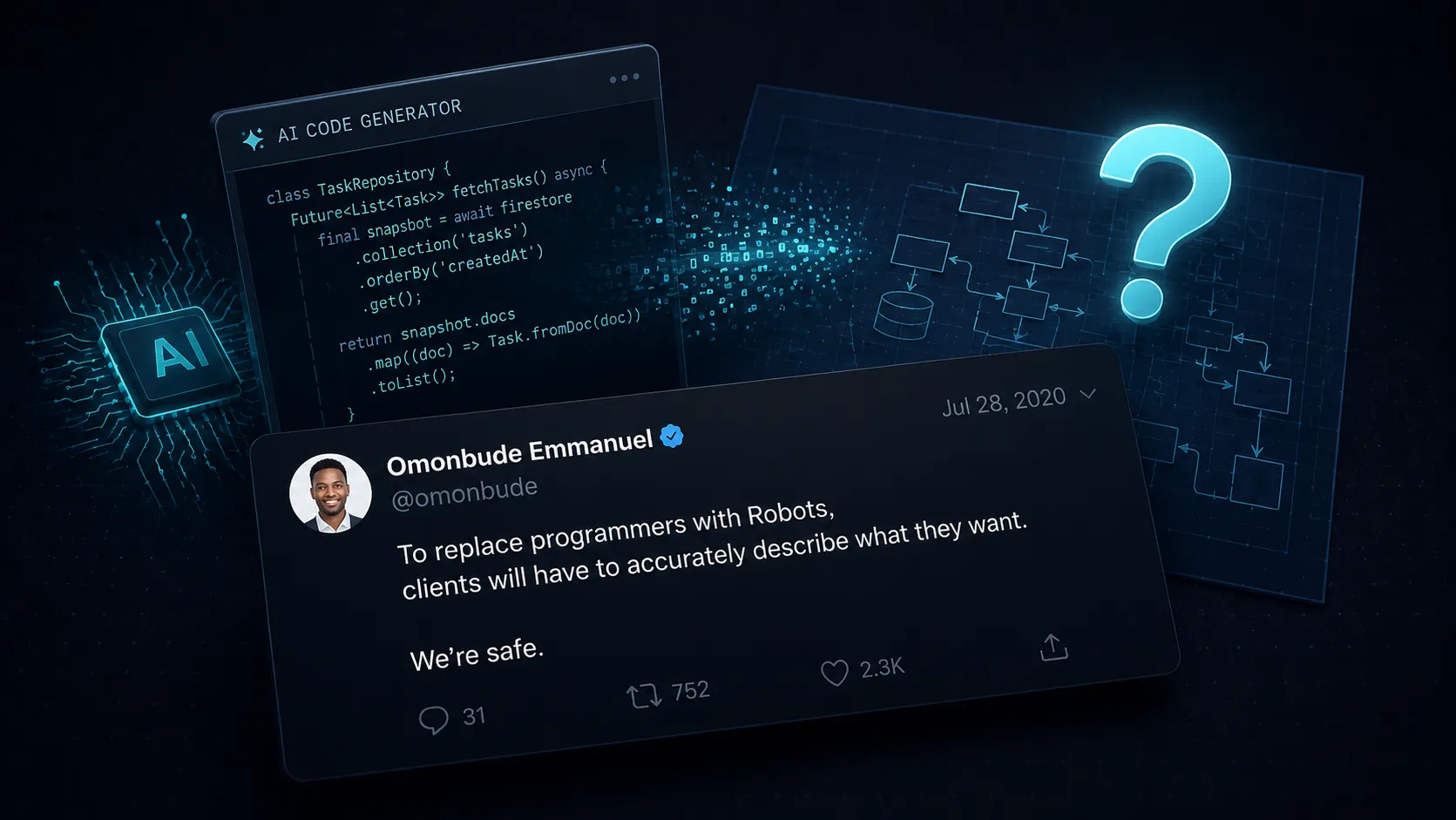
The temptation, when AI can generate working code in seconds, is to treat architecture as something the AI is doing implicitly. It isn’t: an LLM completes patterns; it does not reason about systems. When you ask it for a payment integration, it produces code that integrates a payment. When you ask it for a user account system, it produces code that creates user accounts. What it does not do is hold the whole product in its head and ask: do these two systems share state correctly under failure conditions? does the data model survive a feature change six months from now? is the boundary between the client and the server in the right place? Research from Google DeepMind on large language models confirms that while LLMs excel at simple retrieval tasks, they consistently struggle with global structural reasoning and long-range dependencies.
Those questions are the work of architecture, and they are the work that determines whether you end up at week 16 building features or firefighting bugs. The dev team that did this work in week 1 may have shipped fewer features in the demo, but they have a foundation that holds the next twelve features without collapsing. The dev team that skipped this work shipped faster early and now cannot ship at all.
This is the part vibe coding cannot fix on its own. AI is fast at the generation step. It is not yet good at the architectural reasoning step: the step where you decide what NOT to build, what to defer, what to make explicit, where to put the boundaries. That step requires a human who has built systems before, knows where they tend to break, and is paid for judgment, not output. The same gap is reappearing now that AI is moving from writing code to generating interfaces. We unpack it in The Hard Part of GenUI Isn’t Generating the UI .
What “built right” actually means
At Pocket Dev, we use AI tools every day. We are not anti-AI; we are anti-pretending that AI removes the need for engineering judgment. The difference shows up at three points in every project:
- Clear architecture. Before we start generating code, we draw the system: data model, state ownership, module boundaries, external integrations, failure modes. The AI then generates code inside that architecture, not in place of it.
- Scalable foundations. The code is structured so that the second feature is easier than the first, not harder. The fifth feature reuses the patterns established in the first four. The tenth feature does not require a rewrite of the first.
- Code humans can maintain. Anyone reading the codebase a year from now (us, or whoever maintains it after us) can find their way around. Functions do what their names say. Modules have clear responsibilities. The AI was used to write code that humans can own, not code that only the AI can navigate.
None of this is anti-AI. All of it is human judgment about how AI gets deployed. The output looks like what the AI generated, but the structure around it (the part you cannot see by reading any single file) is what determines whether the codebase still works in week 16.
If you are already in week 8
Most founders we talk to are not at week 1. They are at week 8 or 12, they have a working-ish prototype, they have spent real money, and the question is not should we build with AI but what do we do with what we already have.
It depends on what was built and how. Some parts can be salvaged. Some parts need to be rebuilt. The diagnostic is not something you can do by feel. It requires reading the code, mapping the architecture that exists (or doesn’t), and being honest about the trade-offs. That is what a proper scoping engagement does: a short, fixed-price piece of work that produces a clear answer to where you actually are and what the rest of the build costs to do right.
If you are at week 1 and have not yet started, the better article to read first is Hiring an App Developer? Two Questions Every Founder Should Ask First . It is the diagnostic you can run on a prospective dev team in thirty minutes, before you have paid anyone anything.
[ NEXT STEP ]
Carrying a vibe-coded codebase that has started to crack?
The Product Blueprint is a fixed-price, two-week diagnostic that reads your existing code, maps what is actually there, and tells you honestly which parts can be salvaged and which need to be rebuilt before more features get added on top.
BOOK_A_ROADMAP_CALL →