[ THE_SHORT_ANSWER ]
Working code runs in a development environment. Production-ready code survives real users, scale, failure, and change. AI generates the former quickly; the engineering layer between them (performance under scale, security, architectural fit, and failure modes) is still human work.
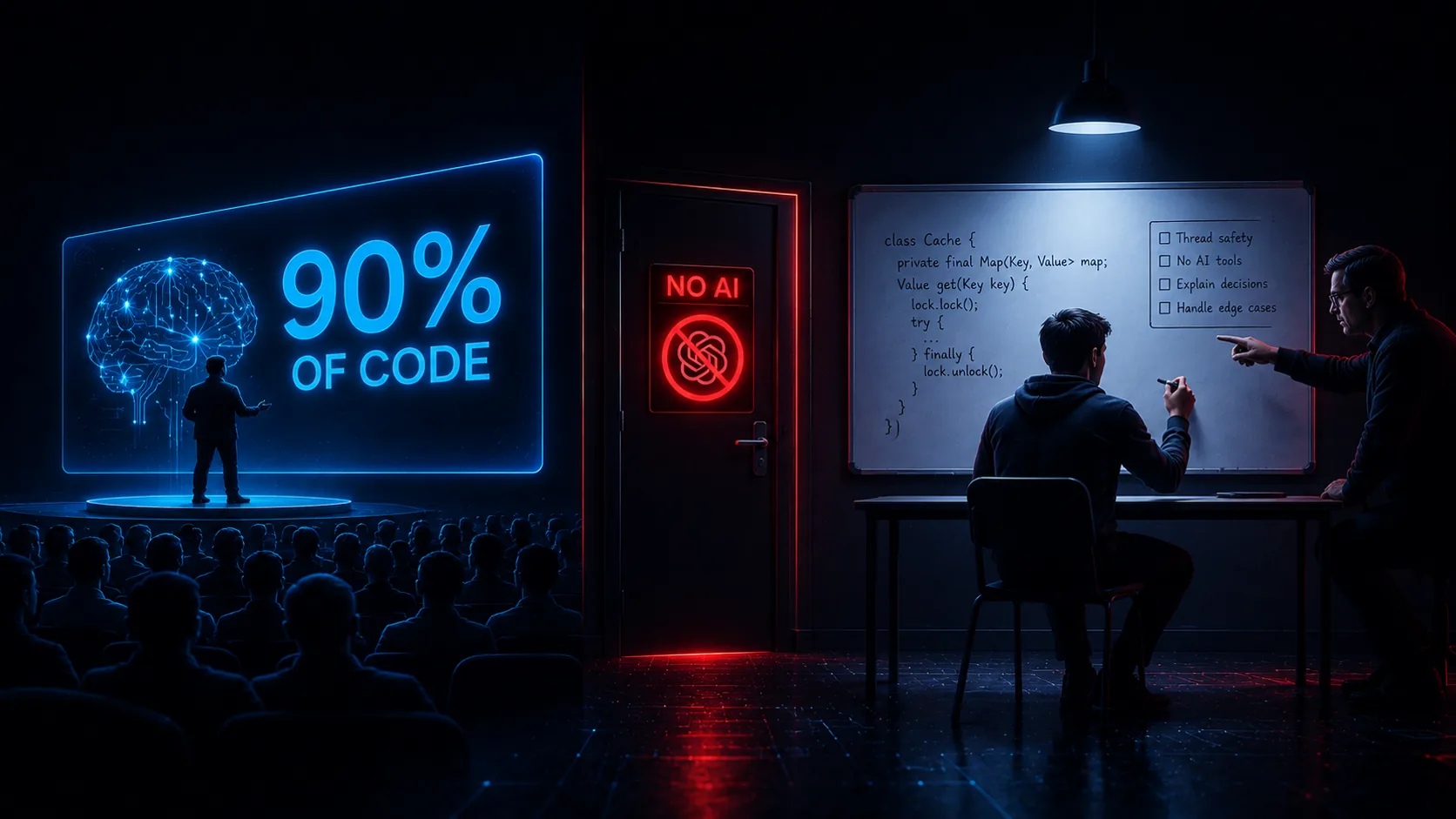
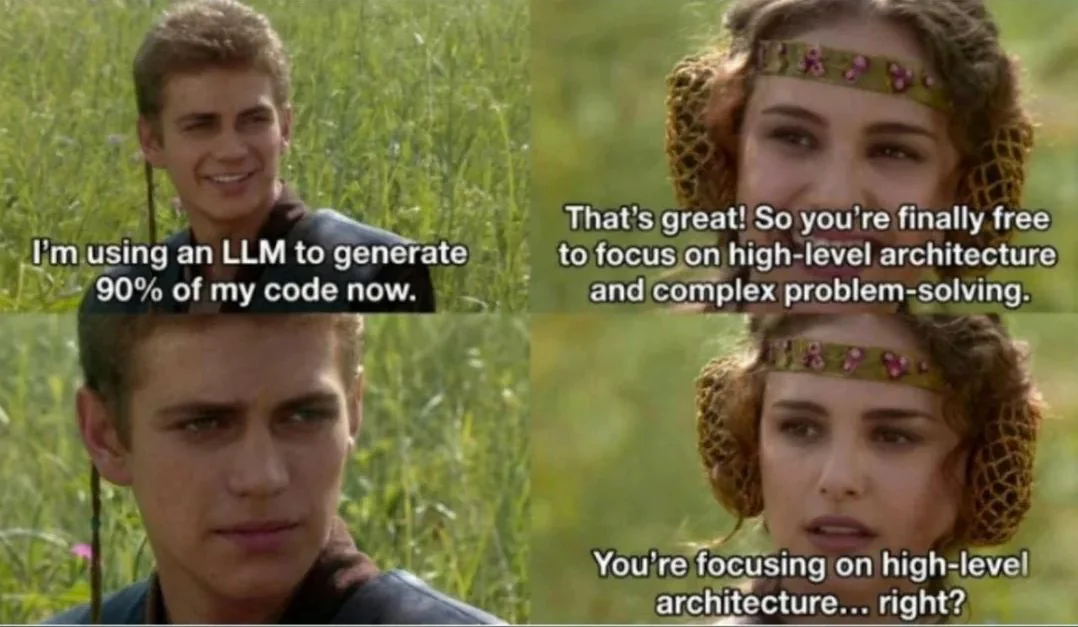
The scariest thing about AI in software development is not that it will replace developers. It is that it is making us complacent. It is seductive: you describe what you want, the LLM produces a block of code, the code runs without errors, you ship it. The feedback loop is so fast it feels like 10× productivity.
The trap inside this experience is the unspoken assumption that working code and production-ready code are the same thing. They are not. Code that runs on your laptop, with perfect Wi-Fi, your single test user, and no concurrent load is the easiest possible test of software. Production is when fifty people click Submit at the same time, the internet drops mid-payment, the user types an emoji into a field that did not expect one, and a 5 GB file gets uploaded as a profile picture.
The difference between those two contexts is the engineering layer. It is the work AI does not yet do, and almost certainly the work you are paying a developer to do, whether you are getting it or not.
What the LLM does not care about
An LLM is, fundamentally, a pattern completer. When you ask it for a database query, it produces a query that looks like the queries in its training data. When you ask it for a payment integration, it produces an integration that looks like the integrations in its training data. The code it produces is often syntactically correct and frequently functionally correct for the happy path. Research from Microsoft Research on AI-assisted programming confirms that while LLMs generate correct code for common patterns roughly 70% of the time, they rarely consider edge cases, performance implications, or system-level constraints without explicit prompting.
What it does not do (and what is invisible from the outside if you do not know to look) is reason about the things that determine whether the code survives production:
Performance under scale
A loop that’s O(n²) will pass every test you run during development, because you’re testing with ten records. Six months later, when the table has a hundred thousand records, the same code takes thirty seconds to run and your CPU is pinned. The LLM did not flag this because it was not asked to.
Security
It will import a dependency with a known CVE because that dependency shows up frequently in its training data. It will write authentication code that works for the happy path but mishandles edge cases: token expiry during a session, password resets after an account is compromised, the user who is logged in on two devices simultaneously. It will store sensitive data in places where the data is technically accessible but should not be. None of these are visible in the running app until someone exploits them. The OWASP Foundation’s security projects confirm that AI assistants frequently introduce vulnerable patterns when handling authentication, data storage, and input validation.
Architectural fit
It solves the local problem in front of it without asking whether the solution fits the architecture of the rest of the system. If your app uses event-driven state management, it might write a function that bypasses the event system entirely. If your data model assumes immutability, it might write a function that mutates in place. Each of these creates technical debt that compounds. The code works today; it breaks the system’s consistency tomorrow.
Failure modes
An LLM completes the path you asked it to complete. If you asked it to handle the happy path, it handles the happy path. The unhappy paths (network failure mid-request, partial writes, race conditions, a third party returning an unexpected response shape) are the ones it tends to miss, because nobody asks for those out loud during code generation. A senior engineer asks for them as a reflex because they have seen production break in those exact ways. We wrote about how those missed paths show up in the product itself in The Edge Cases Are the Product .
The engineering layer that has not changed
All four of those gaps share a structure. They are not problems of writing code; they are problems of thinking about code. They are the work that turns code-that-runs into software-that-ships.
Three years ago, Google and Stack Overflow could point a developer in the right direction, and occasionally provide the exact snippets they needed. AI now generates the entire component faster than the developer can describe what they need. The leap in capability is real. But the definition of real engineering expertise hasn’t budged a millimetre. The gap between average and great was rarely about who could produce code the fastest, and AI has made that skill nearly worthless anyway. As Martin Fowler has written extensively about software design principles, the ability to recognize good architecture and make sound technical decisions remains the defining characteristic of senior engineers.
What it is still about is three specific skills:
- Knowing exactly the right questions to ask. The questions that determine whether the solution fits the problem, not whether the code compiles. Will this scale? Where does it fail? What is the worst thing a user can do? What happens when the network dies?
- The intuition to discern the right solution from a sea of plausible options. AI generates a plausible answer to almost any prompt. A senior engineer can tell which of three plausible answers fits the system they are building and which two will silently introduce debt.
- The ability to stitch those answers together into a cohesive, scalable, robust system. AI gives you pieces; engineering is what makes the pieces fit. Without that step, you have a pile of generated code; with it, you have software.
None of these are skills AI has yet. They require having shipped production software before, having been on the other end of a 2am incident when the database is locked or the payments API is silently returning 503s, and remembering what broke. The Google SRE book documents that production incidents follow predictable patterns: cascading failures, resource exhaustion, race conditions, and dependency timeouts. That pattern recognition comes from having lived through the incidents, not from generating more code.
What this means when you are buying software
If you are a founder buying a build, this is what you are actually paying for. Code is increasingly free, so what you’re really buying is the engineering layer around it: the judgment about which patterns fit your problem, the discipline to test what could fail, the architectural choices that determine whether the second feature is easier than the first or harder than the first.
A team that uses AI well still does this work. They use AI to accelerate the generation step (which is real and valuable) without letting AI replace the reasoning step. You can tell which kind of team you are talking to by the answers they give to specific questions about how they would handle scale, failure, and security. We wrote about the two highest-leverage questions to ask in Hiring an App Developer? Two Questions Every Founder Should Ask First .
If you have already built something with AI and are starting to suspect the engineering layer was skipped, the symptoms are usually visible by week 8. We covered the typical arc (what cracks first, where the rebuild conversation happens, and why the cost compounds) in Vibe Coding 16 Weeks Later: The Hidden Cost of Building Software on AI Vibes .
The Pocket Dev approach
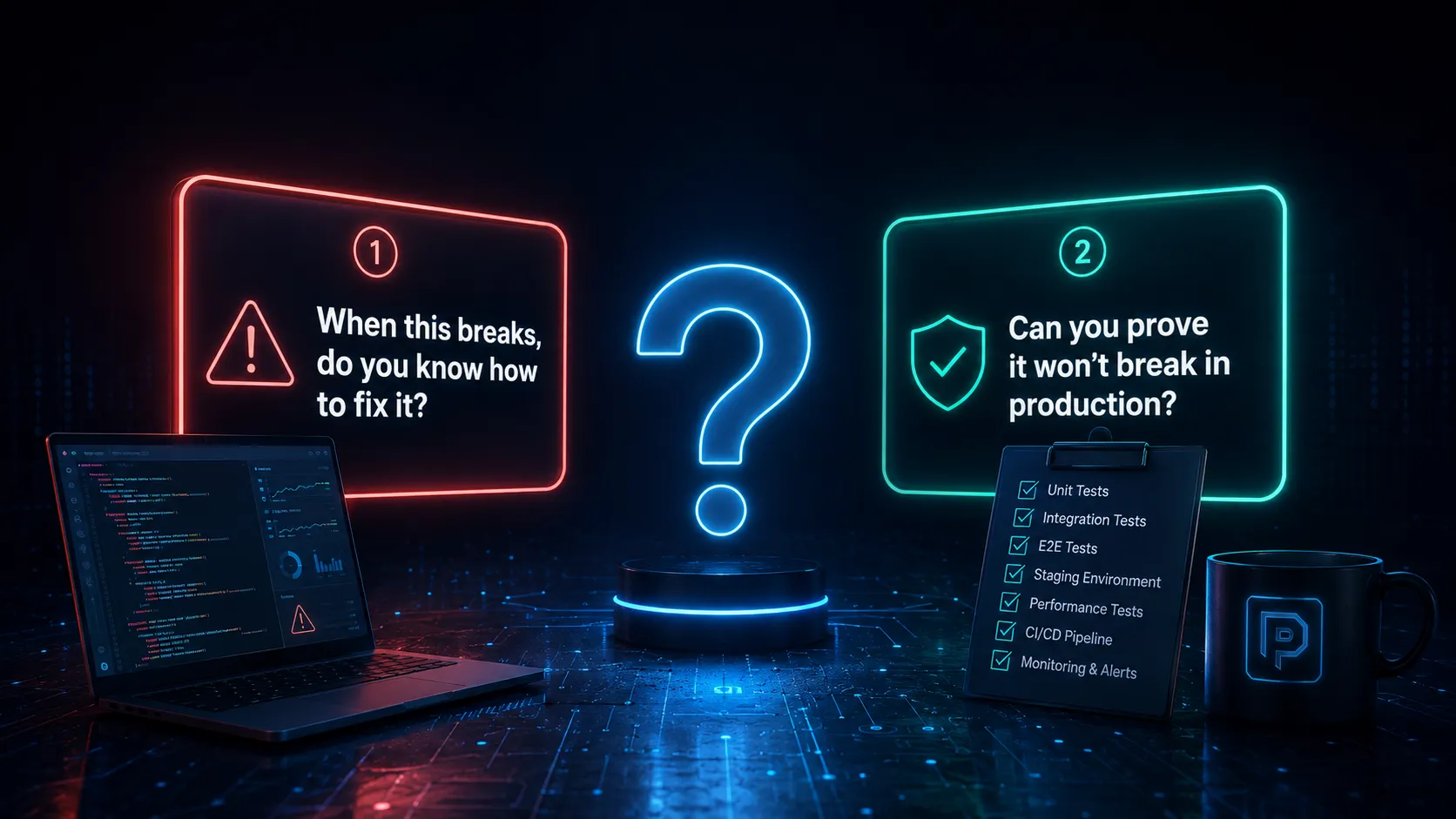
We use AI as a tool inside an engineering process, not as a replacement for one. The process looks like this. Architecture first: what data flows where, what fails, what scales. Generation second: AI writes the code inside the architecture we designed. Review third: every generated block is read by a human who understands what production looks like and asks the questions AI cannot. Testing fourth: automated tests, staging environments, monitoring. Deployment fifth: a pipeline that catches regressions before they reach real users.
That’s the same engineering discipline that has always made software work, applied to a new situation: how much code AI can now produce inside it. In 2026, the useful way to think about AI is as an extraordinarily productive intern: capable of generating useful code at a rate humans cannot match, and still requiring an engineer in the loop who knows what to ask for and what to reject.
The speed of generation doesn’t excuse a team from engineering discipline. Teams that skip it tend to move fast for the first few weeks and then get stuck as the codebase outgrows what anyone understands. Teams that keep the discipline move slower at the start and are still shipping features in week 16.
[ NEXT STEP ]
Want a senior engineer to read what your team has actually built?
We start with a fixed-price, two-week diagnostic. We read the existing code, map the architecture (or what passes for it), identify the production risks before users find them, and give you a clear, honest picture of what the rest of the build costs to do right.
BOOK_A_ROADMAP_CALL →