[ THE_SHORT_ANSWER ]
AI collapsed the cost of writing code and moved the bottleneck to specifying what to build: translating fuzzy human intent into precise, deterministic systems. That translation (asking the right questions, system design, precision) is now the premium engineering skill.
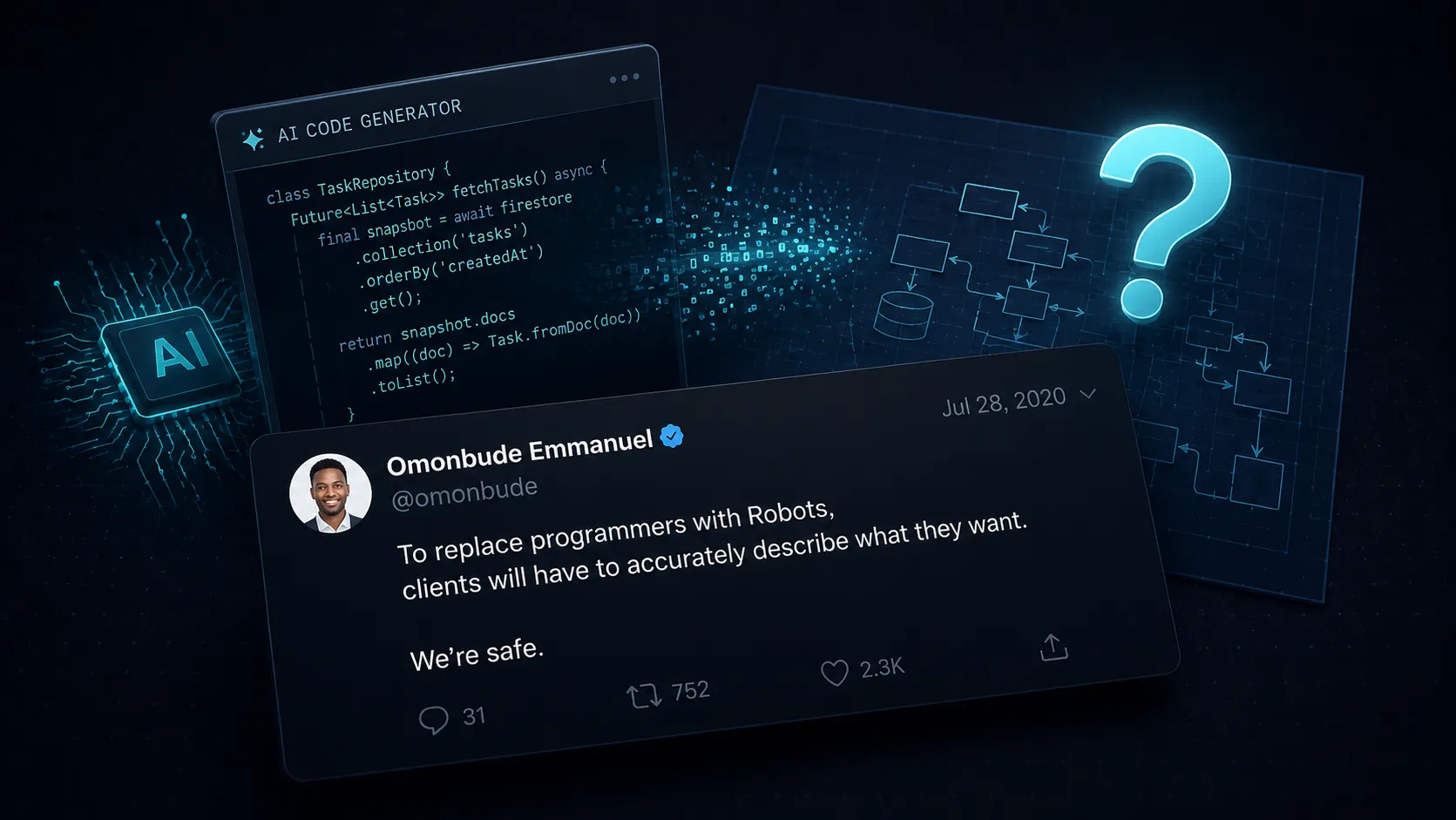
In July 2020, a software developer named Omonbude Emmanuel posted a tweet that quickly became a classic in engineering circles:
“To replace programmers with Robots, clients will have to accurately describe what they want. We’re safe.”
We laughed because it struck a chord. Most people who have shipped software have felt the gulf between a raw business idea and a technical spec. We knew how often projects begin with a vague request and end with “I’ll know it when I see it.” This aligns with what the Standish Group’s CHAOS Reports have documented for decades: unclear requirements and scope creep remain the primary cause of software project failure, with their latest comprehensive research indicating that only around 31% of software projects succeed.
But fast-forward to today, and that joke has quietly become the daily job description.
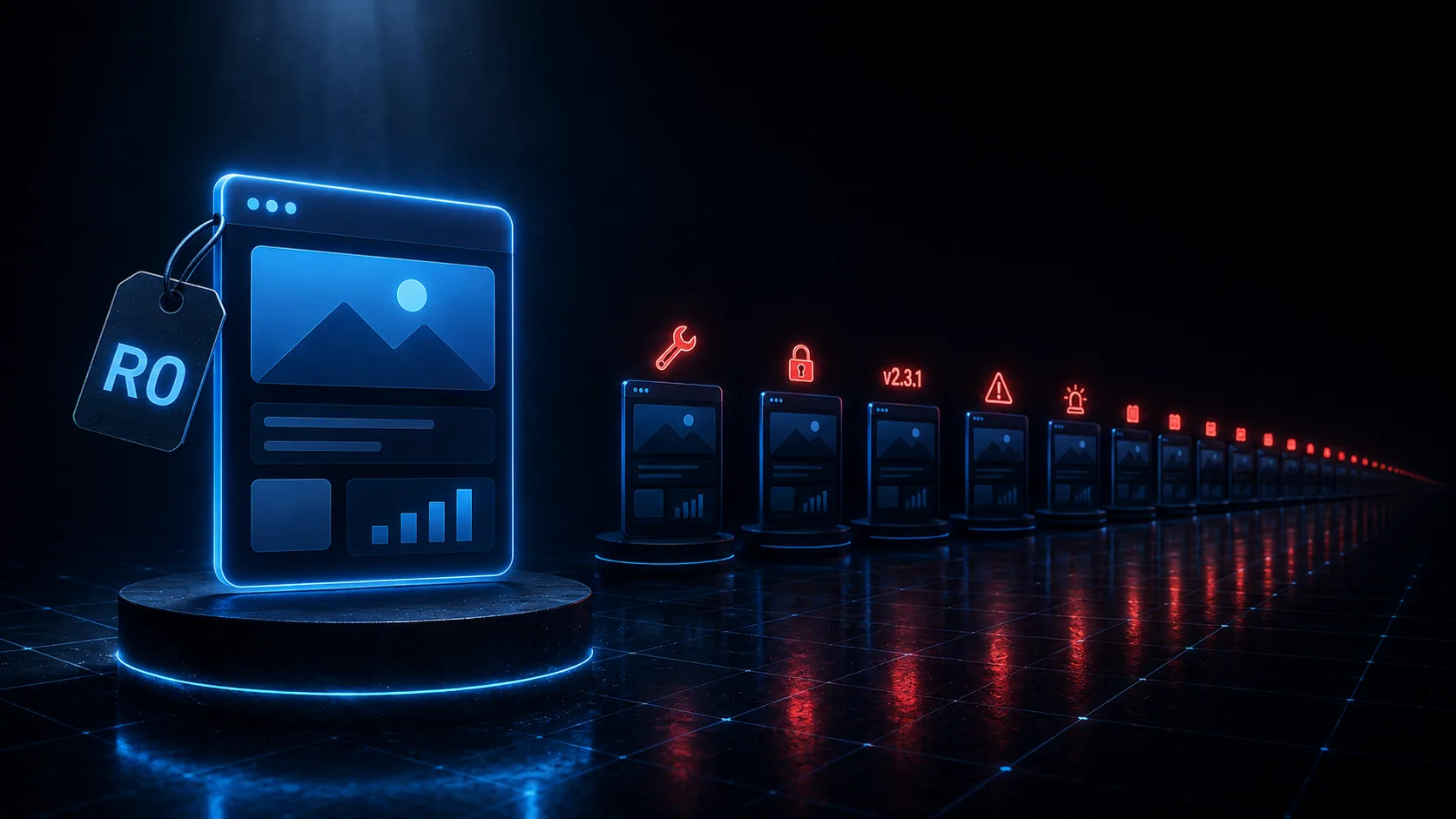
AI tools didn’t eliminate the need for precision, and they didn’t bypass the difficult work of translating human needs into software. They shifted the bottleneck. Generating code is the easy part now; the real work was never typing.
1. The Shifted Bottleneck
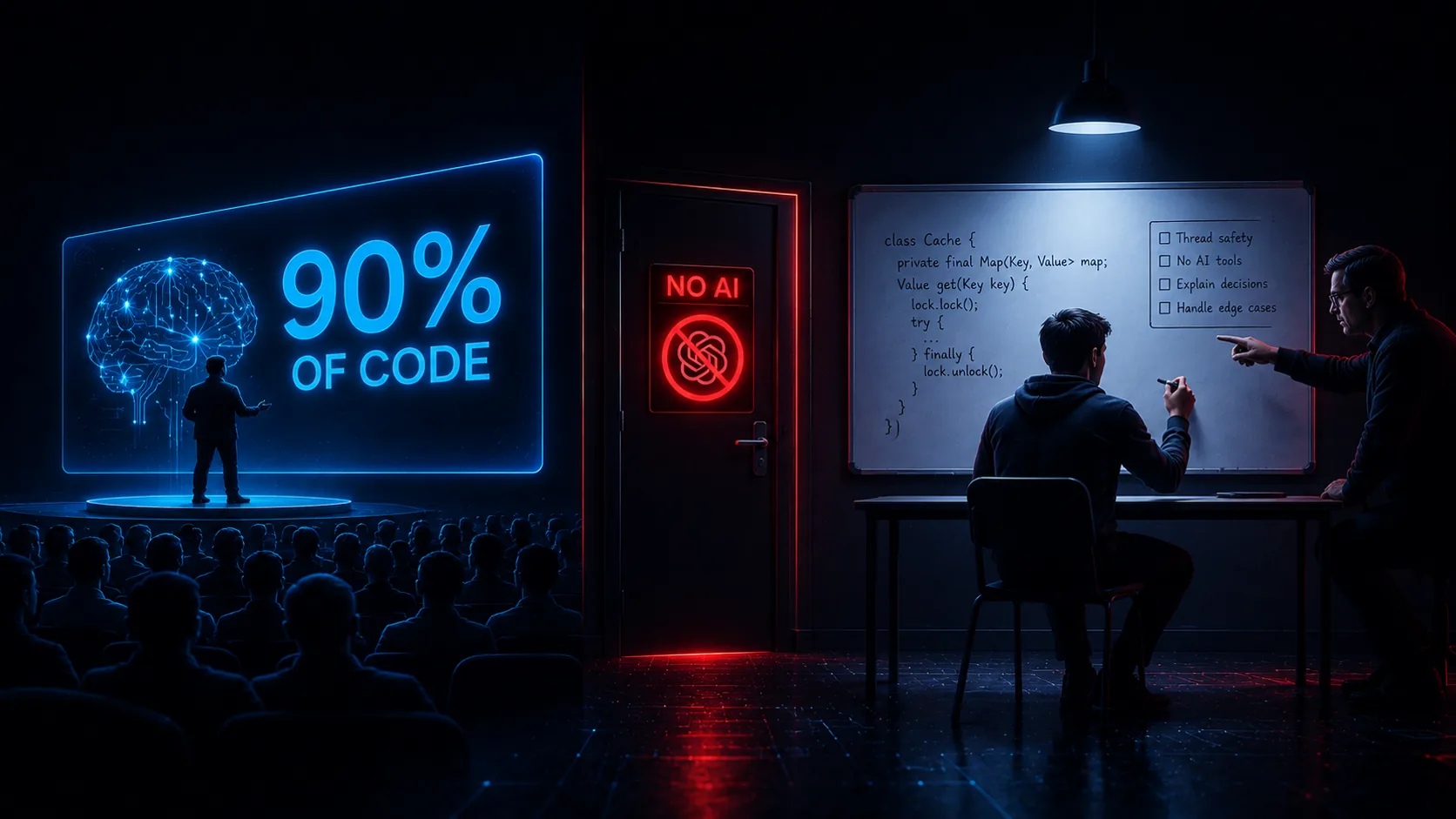
For decades, the syntactic act of writing code was a massive barrier to entry. That is the layer AI has commoditized. If you can describe a basic feature, an LLM can generate fifty lines of valid code in seconds, and the feedback loop feels fast enough to give an early illusion of massive productivity. For instance, a landmark multi-company field study by Cui et al. (2026) analyzing nearly 5,000 developers found that AI assistants increased completed tasks by 26%, while an enterprise trial at Google by Paradis et al. (2024) estimated a 21% reduction in time developers spent on task. Crucially, both studies emphasized that code reviews, testing, and high-level architectural decisions still require significant human oversight.
But coding was never the hard part of software development. It was simply the most visible part. The real bottleneck has always been cognitive: taking a fuzzy, unstructured real-world problem and translating it into an architecture precise enough to survive production. When writing code becomes nearly free, the premium doesn’t disappear. It shifts entirely to system design, clarity of thought, and precise definition.
2. The Confident Guesses of Vibe Coding
When you give an LLM a loose, ambiguous prompt, the ambiguity doesn’t just evaporate. It gets filled in with highly confident guesses. This phenomenon is well-documented in AI research as “hallucination”: when language models generate plausible-sounding but incorrect or incomplete information with high confidence.
This is the primary structural risk of the vibe coding workflow. If you ask an AI model to “build a checkout screen with billing,” it will compile a beautiful, functional-looking page. But under the hood, the AI has had to make dozens of implicit architectural decisions on your behalf:
- It guessed how to manage session state when a network drop occurs mid-transaction.
- It made a call on handling concurrent API requests when a user clicks “Submit” repeatedly.
- It assumed how your database schema should handle subsequent changes.
These guesses are based on standard, generic patterns found in training data. They do not know your business logic, your long-term scale, or your specific database constraints.
The result is a classic trap: the demo looks complete in week one, but by week sixteen, those confident guesses catch up with you. What looked like speed in the beginning turns out to be technical debt, unhandled edge cases, and security vulnerabilities frozen into a black box that no human on the team actually understands.
The dangerous part is that the system doesn’t look broken. It looks finished. The cracks only appear when real customers start creating the edge cases the AI never had enough context to anticipate, and by then the confident guesses are buried deep inside a codebase you are already shipping to paying users.
3. The Hard Part Has Always Been the Translation
The hardest part of building software was never remembering language syntax. It was always turning fuzzy intent into a deterministic, scalable system. The cognitive load of software design (managing complexity, edge cases, and system interactions) is what separates professional engineering from code generation.
Consider what actually happens when you sit down to translate a client’s business need into software. A founder might say:
“I want users to be able to pause their subscription easily.”
That sounds simple. But translating that into production-ready software requires answering a cascade of structural questions:
- Does “pause” mean they immediately lose access, or do they keep access until the end of their current billing cycle?
- How do we handle pending invoices or queued background jobs while the account is paused?
- When they resume, do we charge them a pro-rated amount immediately, or wait until the original billing date?
- How does the data model represent this state transition without breaking queries that depend on active vs. inactive user counts?
If a developer doesn’t ask these questions, neither will the AI. The AI writes code that satisfies the immediate text of the prompt, leaving the real-world edge cases to be discovered by your first paying customers. The same translation problem gets harder when the interface itself starts interpreting language. We explore that in The Hard Part of GenUI Isn’t Generating the UI.
As we covered in Working Code Isn’t Production-Ready Code, “working” means it compiles on a laptop. “Production-ready” means it survives contact with real, unpredictable human users.
4. We’re Safe, But Not the Way We Thought
The viral joke from 2020 was right, but for a different reason.
We are not safe because clients can’t describe what they want and therefore robots can’t replace us. We are safe because the job has changed shape: helping clients figure out what they actually want, then engineering a system to match it.
The teams that view software as a code-generation problem are facing a major shift. But the engineers who act as system architects, product thinkers, and risk managers have never been more critical.
When AI can write the code, the developer’s greatest value now lies in their engineering judgment:
- Knowing exactly the right questions to ask before writing a single line of code.
- Identifying which architectural patterns will scale and which will trap you in a corner.
- Designing the failure states, automated testing suites, and monitoring layers that keep the system upright.
This is the gap we focus on. We use AI tools daily, treating them like productive interns to accelerate construction, but we do the translating, the architectural design, and the precision-mapping ourselves.
If you have a vibe-coded system that has started to crack, or if you are trying to map a new build and need to turn a fuzzy idea into a concrete execution plan, we start by scoping it properly. That is a fixed-price architectural sprint where we step into your project, define the system boundaries, identify the edge cases, and hand you a clear, uncompromised road map of what it actually takes to build it right.
This time it’s true: rigorous human judgment remains the anchor of any production-ready system.
[ NEXT STEP ]
Ready to turn a fuzzy business need into a production-ready application?
The Product Blueprint is a fixed-price, two-week architectural sprint that maps your delivery plan, stress-tests your requirements, and defines exactly how the application holds up when real users hit it.
BOOK_A_ROADMAP_CALL →