
[ THE_SHORT_ANSWER ]
AI collapsed the cost of generating code, so scarcity shifted from engineering effort to attention earned by solving meaningful problems. When building is cheap, product judgment (what to build, and what to refuse to build) becomes the moat.
For as long as the software industry has existed, the primary bottleneck of launching a product was technical execution.
If you had an idea, your first and highest hurdle was translating that concept into working code. You either needed deep technical expertise, a significant budget to hire an engineering team, or the patience to spend years mastering the craft yourself. The code itself was the moat.
Today, that barrier has effectively collapsed. With the emergence of sophisticated AI tools, the timeline from “I have an idea” to “I have a working prototype” has shrunk from months to hours. AI can generate functional code blocks, draft interface designs, and stub out entire applications based on plain-language prompts. According to GitHub’s Octoverse report , generative AI has become standard in software development, with over 1.1 million public repositories now integrating LLM SDKs, while 80% of new developers on the platform adopt AI coding assistants within their first week.
Yet, as the barrier to building has approached zero, a different, far more difficult challenge has emerged. While the number of people shipping applications has exploded, the pool of human attention remains entirely fixed.
The real scarcity is attention earned through solving meaningful problems, not attention grabbed temporarily with a loud marketing campaign or a novel gimmick.
1. The Law of Shifting Scarcity
To understand why this is happening, we have to look at a fundamental rule of economics: every dramatic reduction in the cost of production changes what becomes scarce.
Software isn’t the first industry this has happened to. Economist Erik Brynjolfsson describes this kind of shift as the “Turing Trap” : when technology focuses excessively on replicating human capabilities rather than augmenting them, it drives automation over innovation, whereas the highest value shifts to complementary human skills that the technology cannot replicate.
- When manufacturing became cheaper through industrialization, production ceased to be the bottleneck. The scarce, highly valuable resource shifted to distribution and supply chain management.
- When publishing became free through the internet, the physical printing of words ceased to be the bottleneck. The scarce resource shifted to discoverability and curation.
AI is now doing the exact same thing to software: as the cost of generating an application approaches zero, the scarce resource stops being engineering effort and becomes earning enough trust for someone to try your product, then enough value that they keep using it.
Twenty years ago, technical execution was scarce, and developers who could simply make a database talk to a user interface commanded massive premiums. Today, functional code is becoming abundant, and as abundance increases, value migrates elsewhere: toward insight, toward trust, toward customer understanding and clear product strategy. AI hasn’t replaced these human inputs; it has made them worth more.
2. Defining “Product Judgment”
When it is cheap to build features, the temptation is to build all of them. Because an LLM can generate a new module in seconds, founders frequently mistake feature velocity for product progress. They assume that a product with twenty features is twice as valuable as one with ten. A landmark study by Pendo’s The Hidden Cost of Bad Software found that 80% of features in typical software products are rarely or never used, acting as dead weight that complicates codebases and inflates long-term maintenance costs.
In reality, the opposite is usually true. A product with twenty features is often just twice as confusing.
This is why the most valuable skill in modern software development is no longer coding capability. It is product judgment.
People throw this phrase around constantly, but it is rarely defined. Product judgment is the ability to consistently make decisions that improve a product rather than simply add to it.
It means knowing:
- Which features not to build, despite how easy they are to generate.
- Which customer feedback to ignore because it steers the product away from its core purpose.
- Which complexity to remove to make the user experience feel effortless.
- Which structural trade-offs are worth making for long-term sustainability.
AI can suggest possibilities: ten variations of a checkout flow, twenty potential features for an app. Determining which of those creates the greatest long-term value for a specific user base takes strategic taste, a human quality developed through observation, empathy, and real-world experience.
3. Building in an Age of Abundance
If code is no longer the constraint, the order of operations for founders must change.
Too many founders still begin with a technical question:
- “What can we build?”
Instead, they should begin with a behavioral one:
- “What painful problem keeps occurring?”
Before writing a single line of code, spend time understanding the people you are building for. Watch how they currently solve their problems. Identify where they become frustrated, where their workarounds break, and where they lose time or money. Test whether removing that frustration is valuable enough that someone would willingly change their behavior to adopt your solution, and only then let technology enter the conversation.
AI has dramatically reduced the cost of building the wrong thing, without reducing the cost of misunderstanding your customer at all.
4. Engineering for Survival
Once you have identified the right problem to solve, the execution still matters deeply.
Software that works once and software that keeps working are different achievements, and reality is what tests the difference.
A prototype generated quickly by an AI often assumes a happy path: a fast network, a single user, valid data entry, and perfectly reliable third-party integrations. Real usage looks nothing like that. It is fifty people clicking “Submit” at the exact same millisecond, network connections dropping in the middle of a payment process, unexpected data inputs crashing a database.
The engineering layer around the code is what protects a business from these failures. It is the invisible work of designing architectures that handle errors gracefully, implementing testing pipelines, and ensuring the system is maintainable. AI can help write the lines of code within these systems, but a human engineer must still design the boundaries that keep the system secure and stable under stress.
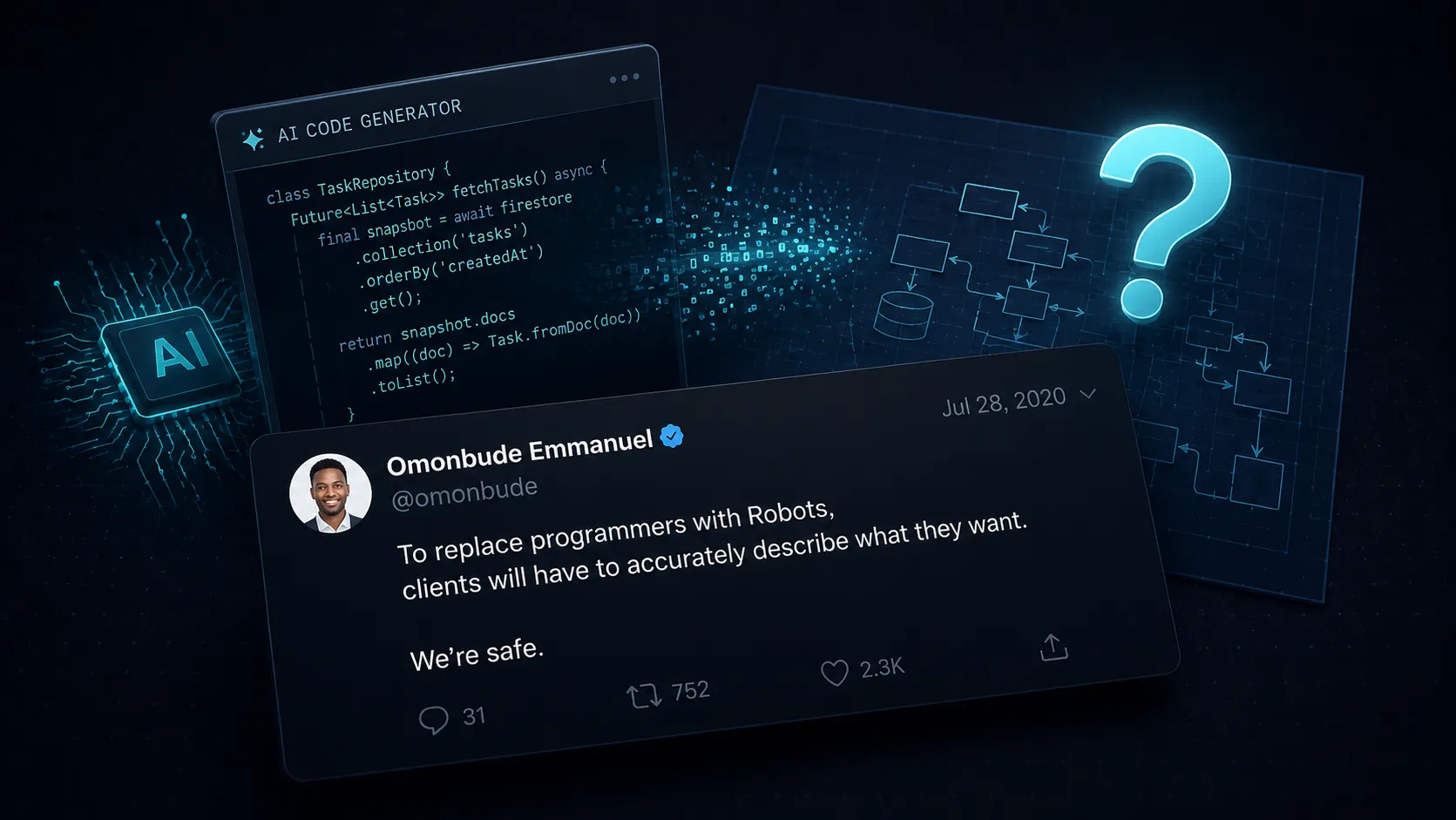
We covered the specific engineering layer AI does not yet replace in Working Code Isn’t Production-Ready Code , and the upstream translation problem in AI Can Write the Code. It Still Can’t Tell You What to Build. . The scarcity shift described here is the economic frame those pieces sit inside.
5. What Hasn’t Changed
At Pocket Dev, we use AI tools every day. We are not interested in writing boilerplate code by hand when a machine can do it in seconds. We use these tools to bypass the friction of development so we can focus our energy on the decisions that actually matter. The Stack Overflow 2025 Developer Survey found that while 92.6% of developers use AI coding assistants, 72% of professionals expressly reject “vibe coding” (generating entire applications from prompts) for professional work, emphasizing that high-level architecture and complex, critical problem-solving must remain firmly human endeavors.
AI has changed what is easy. The difficult part of building software was never actually writing the code. It has always been understanding people well enough to solve a problem they genuinely care about.
That is where successful software has always come from. And as code becomes cheaper, that truth only becomes more important.
[ NEXT STEP ]
Have a problem worth earning attention for?
The Product Blueprint is a fixed-price, two-week architectural sprint where we pressure-test your product thesis, map the architecture, and hand you a clear execution plan—before a single line of code is written.
BOOK_A_ROADMAP_CALL →